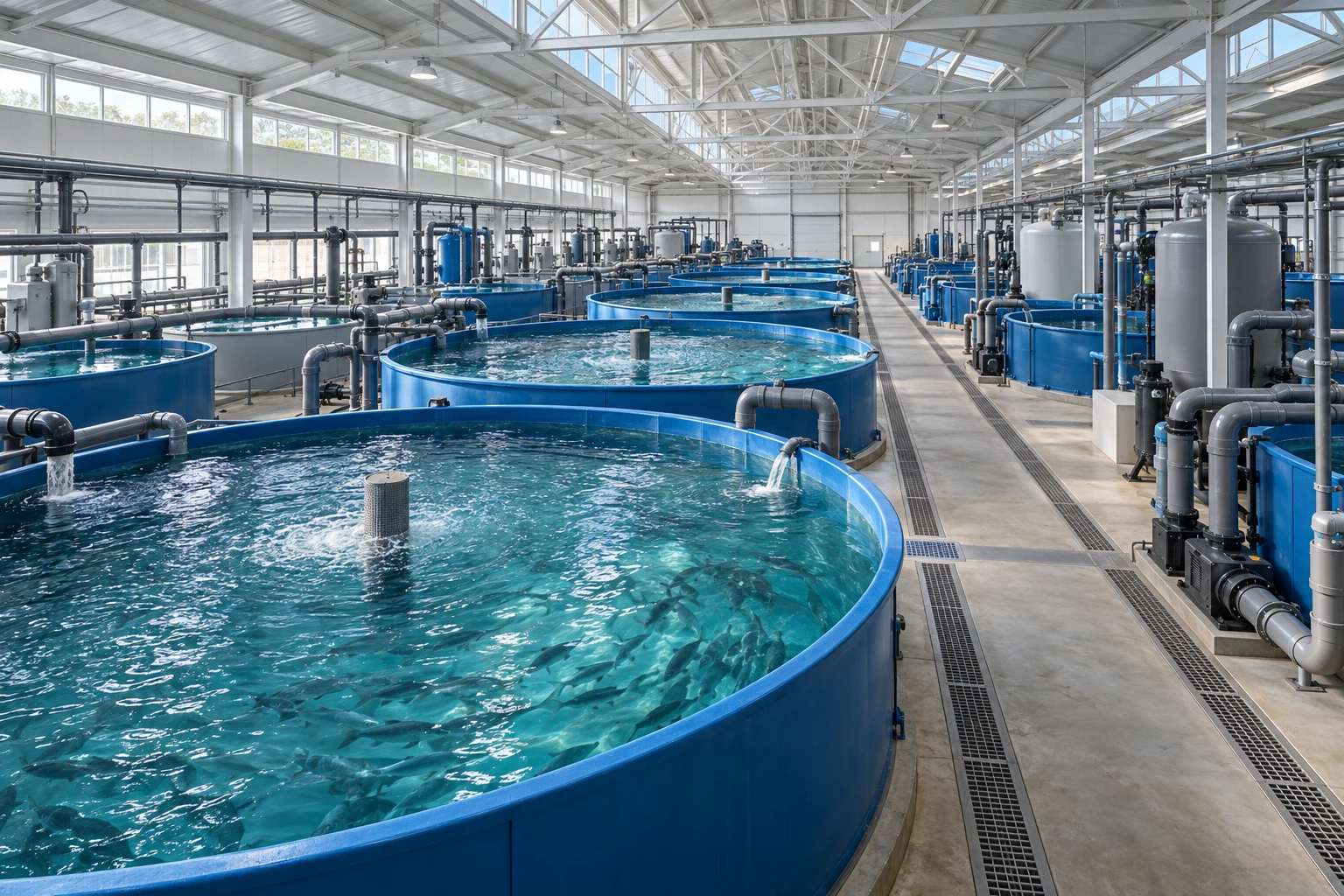
Culture
Arrange tanks around stock management, feeding and daily access. Add production units only with the supporting treatment and oxygen capacity they need.

Bring culture tanks, water treatment, aeration, feeding and monitoring together as connected modules. Start with one facility and expand around real production needs.
Inside recirculating aquaculture
Turn the model. Select a piece of equipment. See how the system supports the fish.
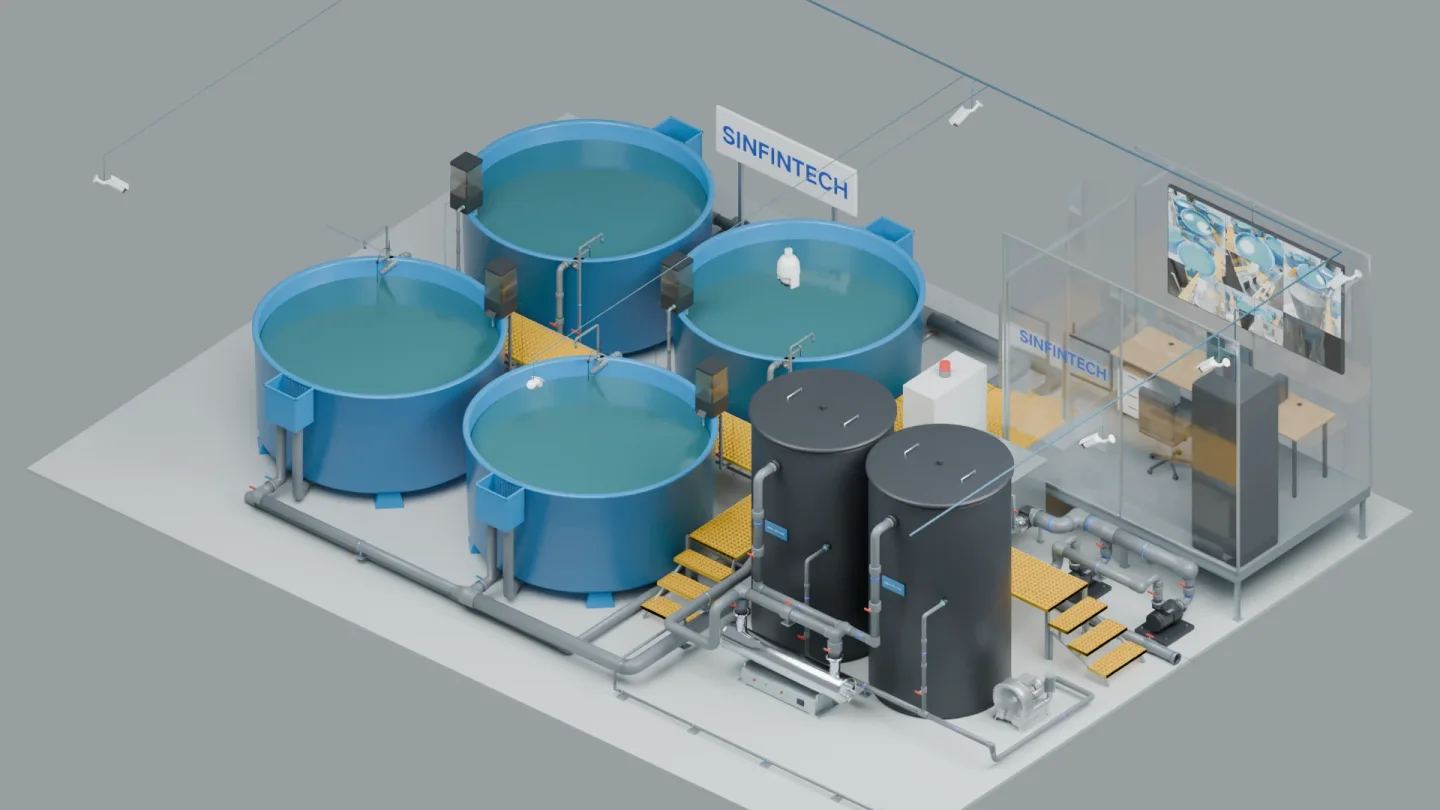
Drag to orbit · Zoom to explore · Select equipment
Designed around indoor freshwater farming
A stable growing environment depends on coordinated work: prompt solids removal, continuous biological treatment, oxygen for the fish, and feeding decisions informed by changing conditions. Modularity keeps those relationships clear as the facility develops.
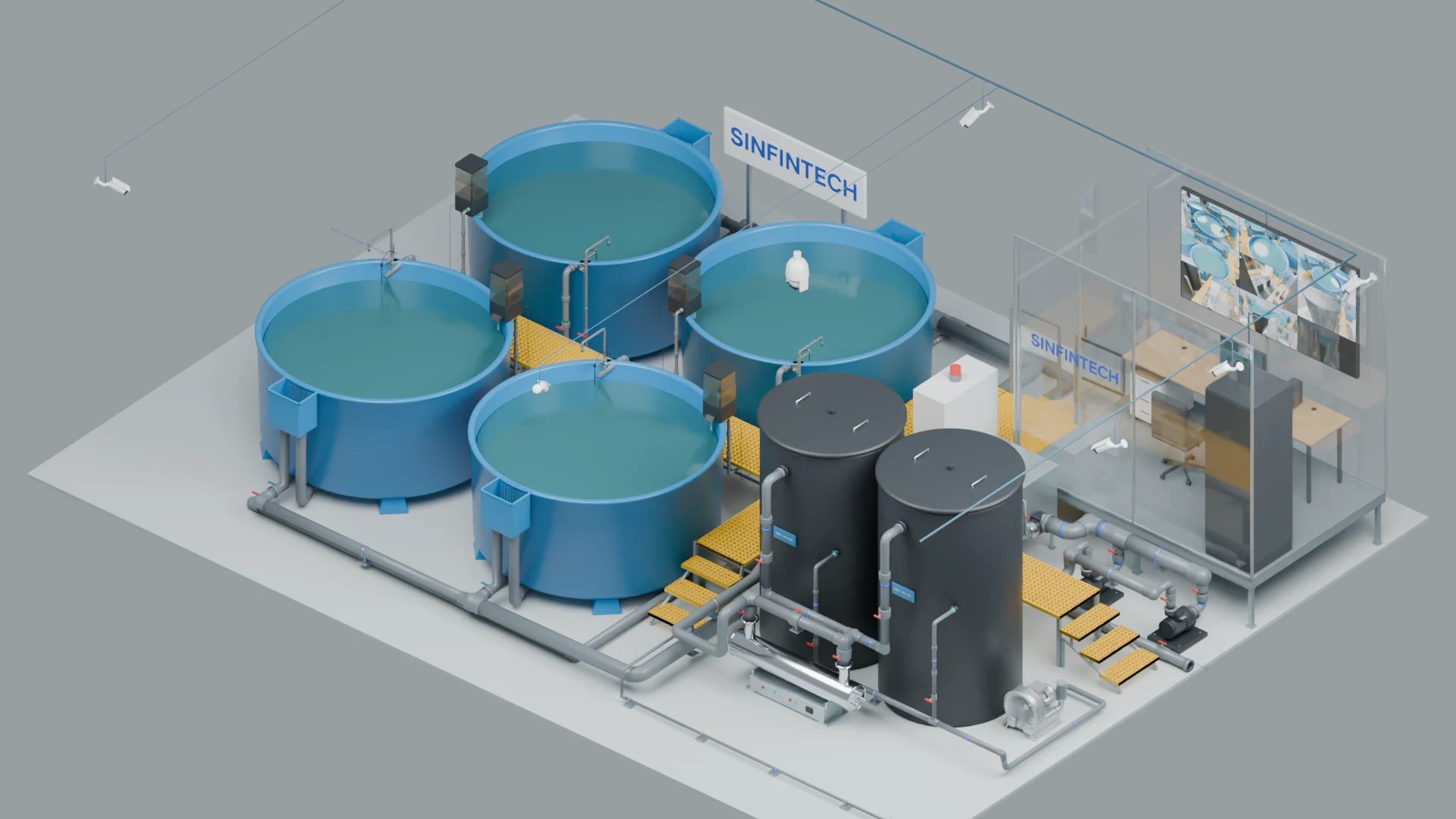
A modular foundation
Arrange tanks around stock management, feeding and daily access. Add production units only with the supporting treatment and oxygen capacity they need.
Remove solids promptly, transform ammonia through biological filtration and manage water quality as a continuous process.
Keep water moving and supply air to both fish and biofilters. Their different demands are served by separate air circuits.
Bring feeding plans, dissolved-oxygen observations and operational records together so the next action has a clear basis.
Follow the water
This sequence follows the current facility model. Recirculation, makeup water, waste discharge and air supply each have a distinct role.
Fish live and feed here. Outgoing water carries suspended waste toward treatment.
A screen separates feed residues and faecal solids before they break down further in the loop.
Move the filtered water through the treatment circuit and maintain the intended flow.
UV exposure helps manage waterborne microbial risk. Effectiveness depends on water clarity, dose and flow.
Microorganisms on moving media convert ammonia to nitrite and then nitrate. Nitrate still needs to be managed through the water-management plan.
Treated water returns to the culture tanks. Makeup water and intermittent sludge discharge remain separate from the main loop.
Beyond the loop, makeup water, waste discharge and nitrate still require management. Tanks and biofilters have separate air supplies. Recirculation does not mean zero water replacement or zero discharge.
An informed operating routine
Dissolved-oxygen trends reveal changes that a single reading can miss. A monitoring plan combines sensors, calibration and routine water testing.
Organise feeding by fish stage and observed response. Operators can adjust the plan as appetite and water conditions change.
Define alert thresholds, responsibilities and response steps. Low oxygen should prompt an investigation of aeration, circulation and feeding.
Keep feeding, water observations, equipment maintenance and stock records together to support the next production decision.
This presentation explains the system and equipment. Live monitoring, automated responses and alerts require integration and on-site validation during implementation.
Optional extensions
These are options to evaluate, not claims of capabilities already operating in the pilot.
Explore early-warning models after enough reliable operating data has been collected.
Use fish-behaviour observations to support feeding adjustments, following site-specific validation.
Evaluate additional oxygenation methods against species needs, transfer efficiency and running cost.
Add metering and compare water, energy and feed use across production cycles.
From concept to operation
Start with species, water source, space, climate and operating goals.
Match tanks with treatment, oxygen, circulation and access requirements.
Check connections, equipment behaviour and the intended process together.
Establish biofiltration and verify performance under the planned load.
Use operational results to guide the next increment of capacity.
Industry practice and published research inform the principles. Results reported in these sources are not performance guarantees for this platform.
FIN by BOAT — Our TechnologyIndoor recirculation, space use and oxygenation as an industry reference.RAS for rainbow trout and the potential for IoT integration (2025)Monitoring and water-treatment principles; species requirements differ.Low carbon footprint of Nile tilapia farming with recirculation aquaculture (2025)A reminder to evaluate treatment, infrastructure and energy together.Start with what matters
Our experts will design a precision agriculture solution tailored to your crops, aquaculture or specialty farming needs. Transform uncertainty into predictable yields.